





MES-class products
MPS and CMMS built on a shared data foundation—orders, scheduling, machine telemetry, OEE, and maintenance working off the same numbers.
MES-class software: one product, a complete set of modules
Production orders
order register and statuses · operations · BOM snapshot at release
Gantt scheduling
timeline planning · scenarios · conflict detection · machine load
Order import
feeds from ERP and files · validation · mappings · session rollback
Machines and telemetry
machine park · data from Nexen · live statuses, downtime, and failures
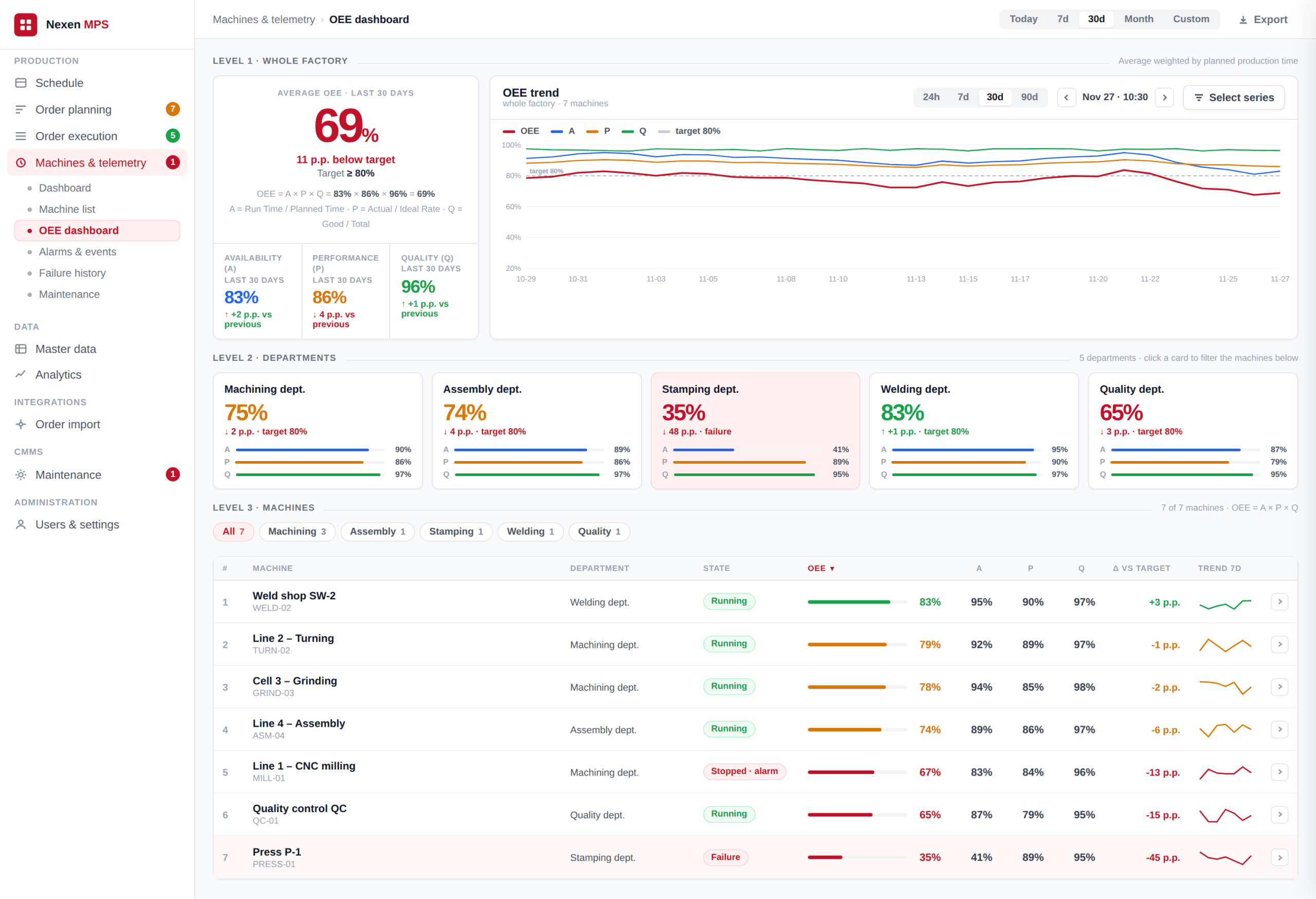
OEE
availability · performance · quality
CMMS
maintenance · service orders · preventive schedules
Master data
products · BOM · routings · resources and dictionaries
Analytics and reports
plan attainment · OTD · bottlenecks · exports and dashboards
From master data to OEE—what the system actually does
Five things have to work in sequence before a production plan is worth anything. The screens below come from the working product.
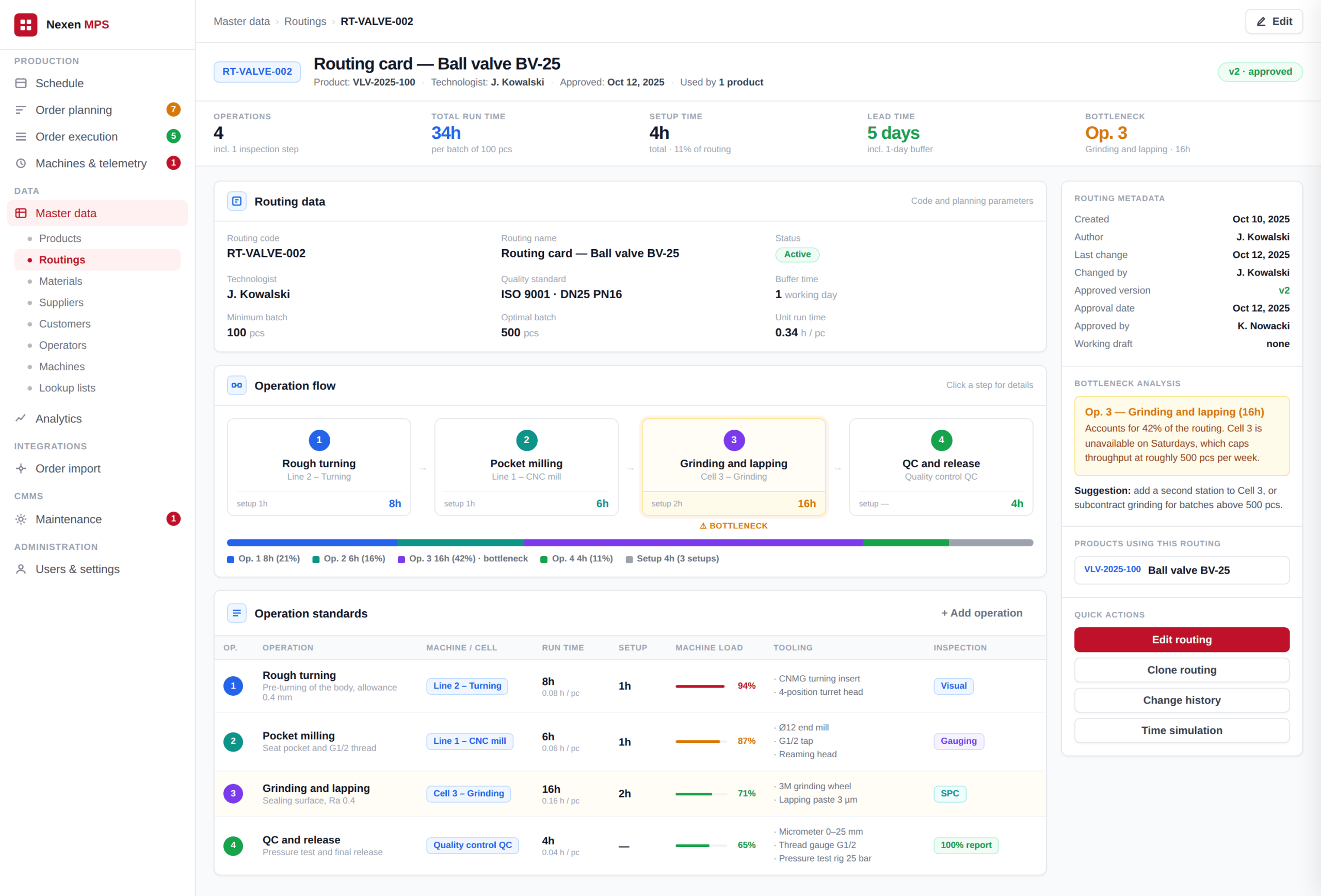
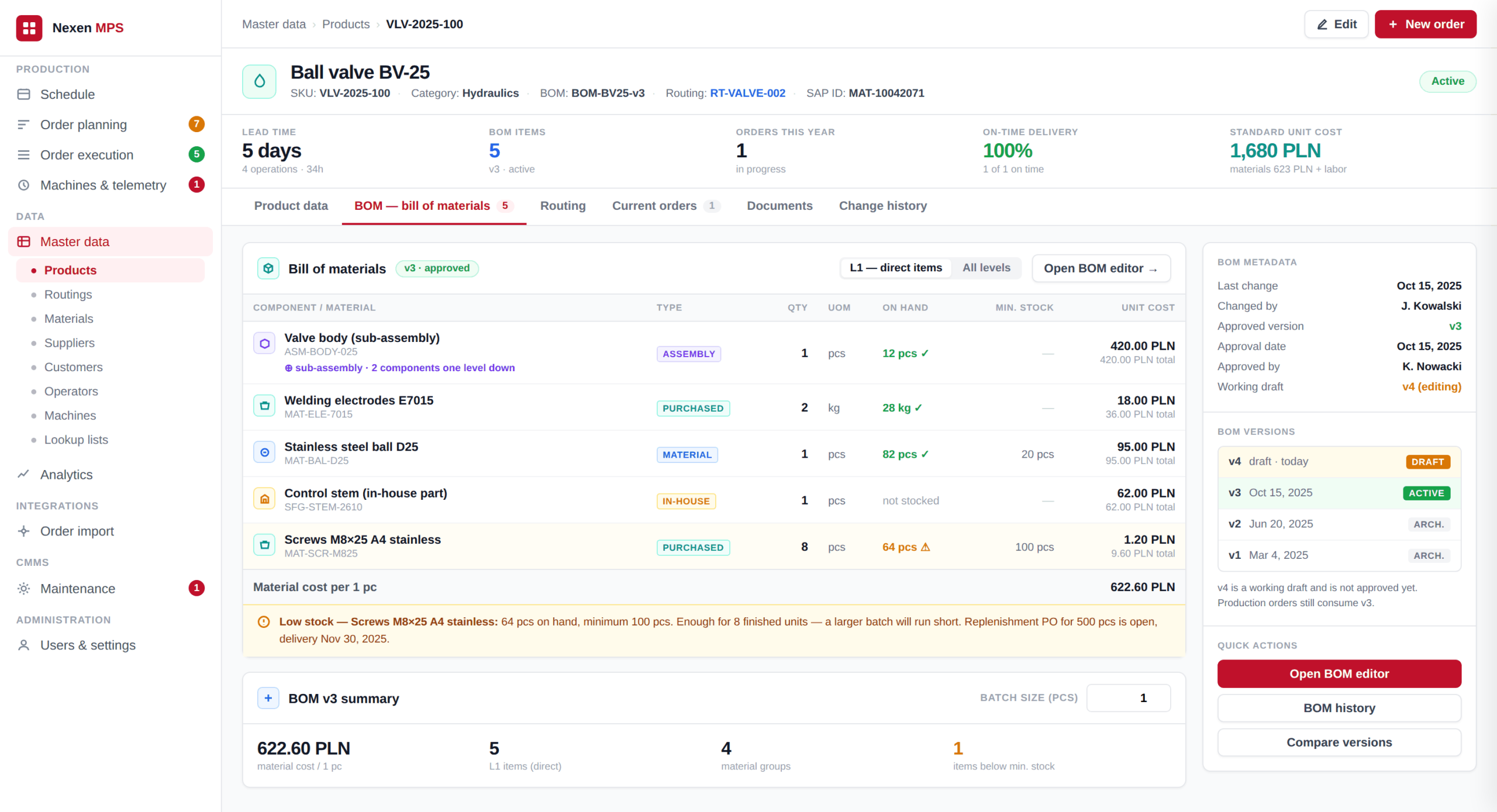
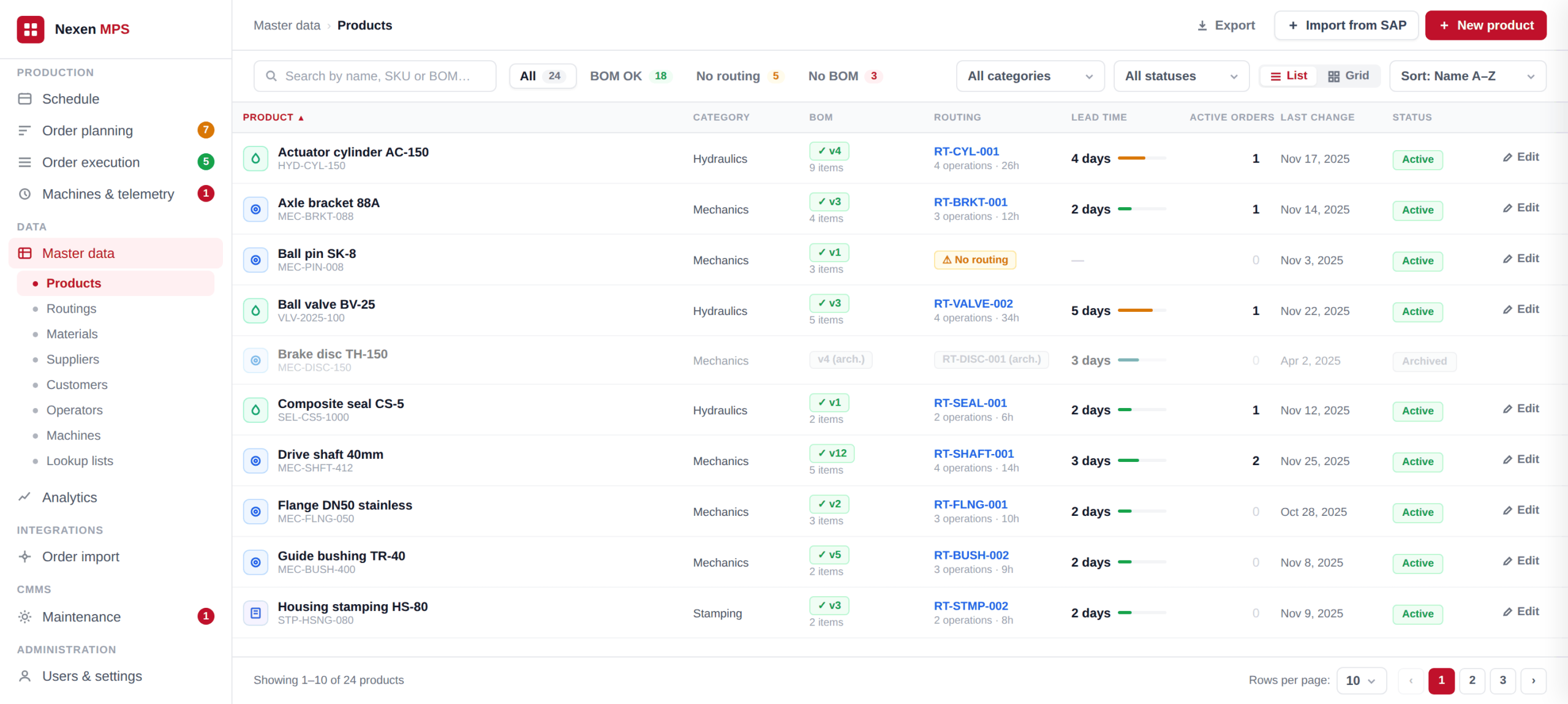
Step 1 · Master data
Product, BOM and routing data in one place
- Multi-level BOM with versioning and approval
- Routings with per-operation standards, tooling and inspection
- Planning reads the approved version while engineering edits the next one
- Data-completeness flags before an order is released
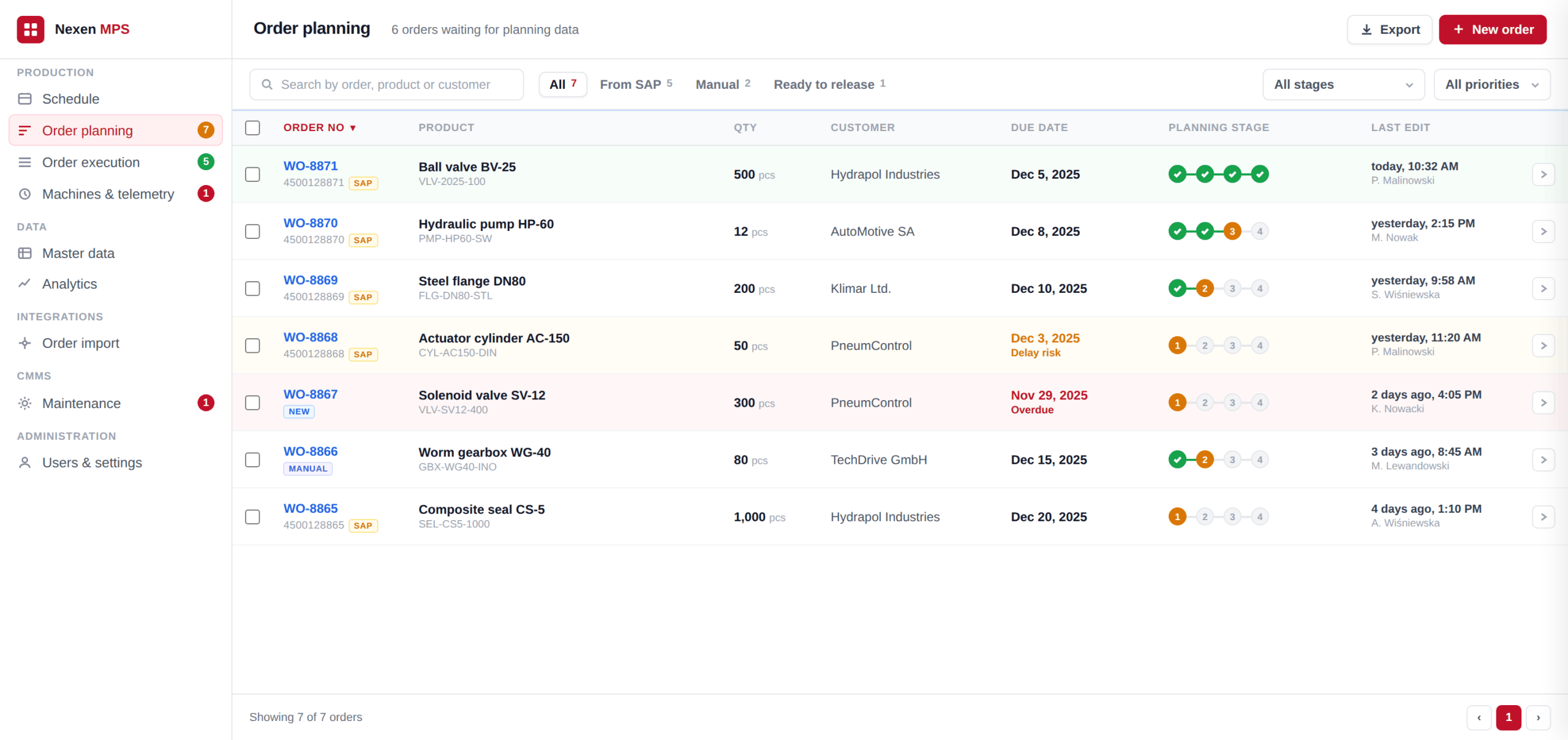
Step 2 · Orders
Orders arrive from SAP, incomplete ones don't reach the shop floor
- SAP import with the source document kept on the record
- Four-stage checklist: routing, materials, capacity, release
- Incomplete orders stay blocked and visible, not hidden
- Manual orders for one-off and service jobs
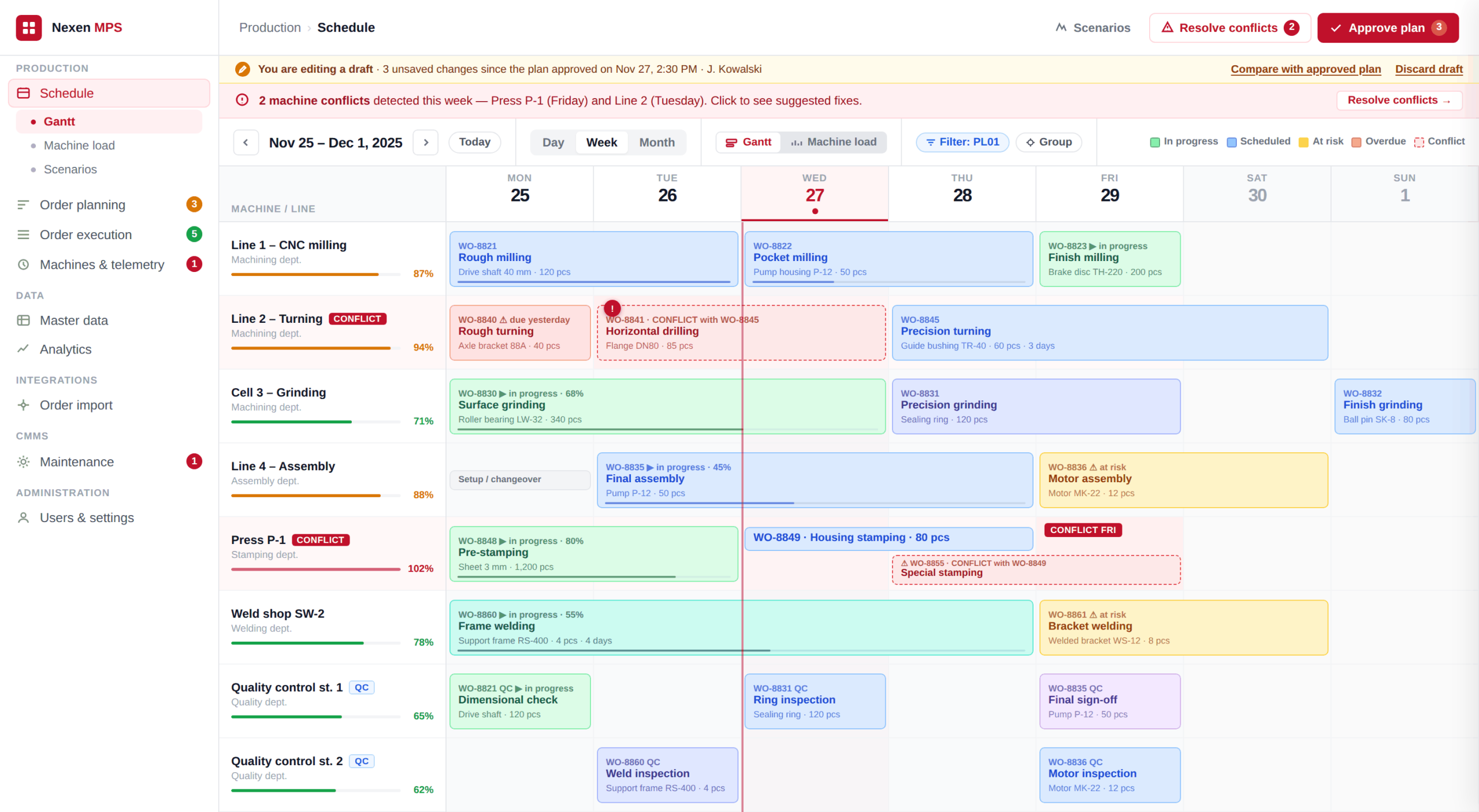
Step 3 · Production schedule
A finite-capacity schedule that shows its own conflicts
- Machine-level Gantt with utilization per work center
- Conflict detection with suggested reschedules
- Drafts approved before they reach the shop-floor terminals
- Day, week and month views of the same plan
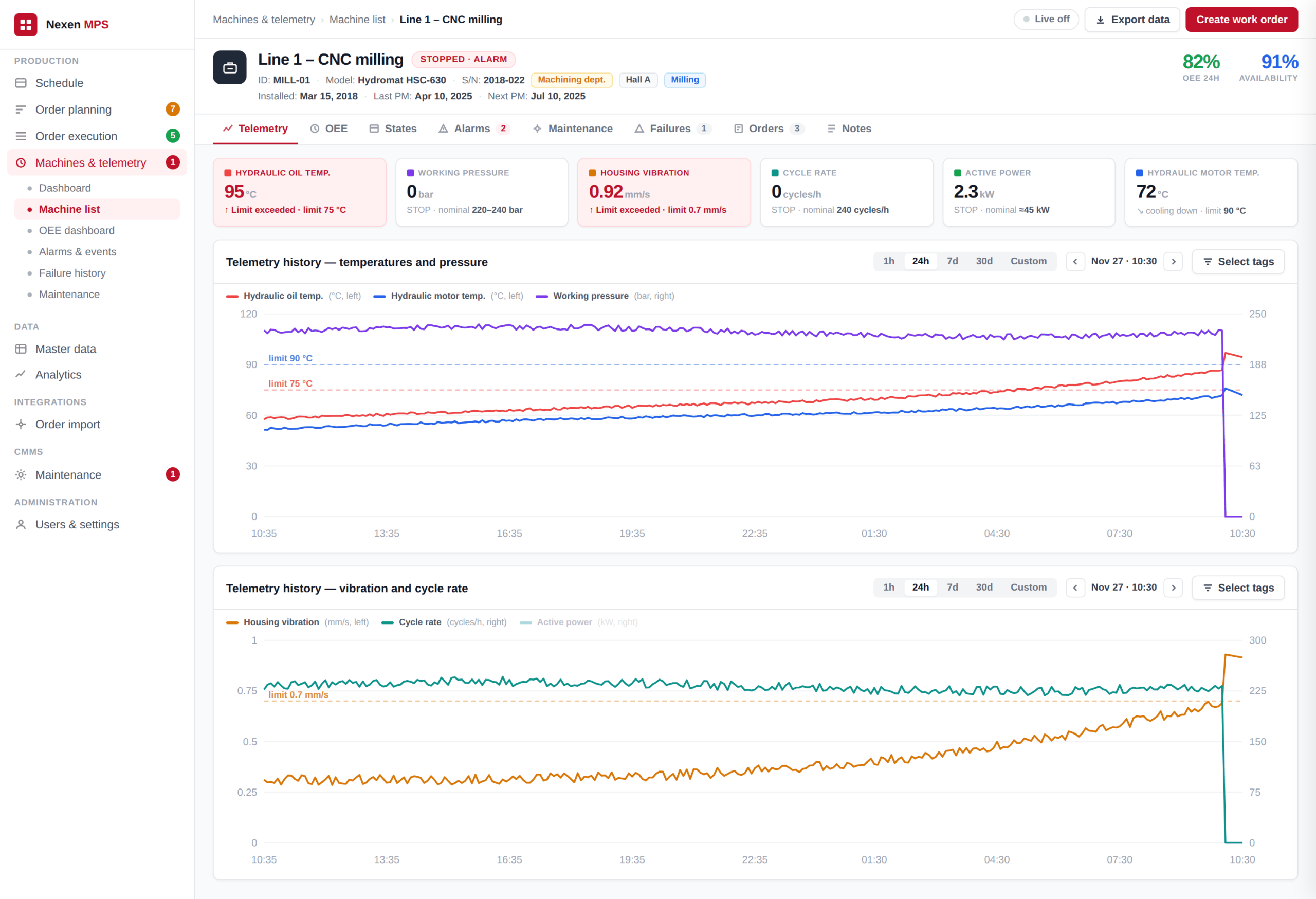
Step 4 · Machine data
Signals from the machine, not from a shift report
- PLC and sensor tags read directly, with per-signal limits
- Alarms tied to machine state and downtime reasons
- Temperature, pressure, vibration, cycle rate and power on one timeline
- History per tag, from one hour to 30 days
ERP INTEGRATION
SAP and other ERP systems
Orders and confirmations both ways, source document kept.
SHOP-FLOOR DATA
PLC, OPC UA and sensors
Direct signals, or retrofit sensors where the controller won’t talk.
DEPLOYMENT
Cloud or on-premises
Runs without an internet link when the plant needs it.
SCOPE
Modular, not all-or-nothing
Start with telemetry and OEE, add planning later.
How to start
1. Workshop and audit
- Scope. Master data as it is today, the ERP handover, what the controllers can report.
- Result. Gap list, target architecture, pilot scope with success criteria, costed plan.
2. Pilot on one area
- Scope. One line: routings and BOMs cleaned up, orders from the ERP, machine data connected.
- Result. A working schedule, OEE from your own machines, a business case.
3. Decision based on data
- Scope. Pilot results against the criteria agreed in the audit.
- Result. Go / no-go with scope, budget and timeline.
4. Deployment
- Scope. Rollout in stages, without stopping production.
- Result. Production system, ERP integration, trained planners and operators.
5. Scaling
- Scope. More lines and sites on the architecture already in place.
- Result. One plan and one OEE definition across sites.
Start with an audit or a pilot
Workshop and audit
Find out what your data is worth before you spend anything on collecting it.
Pilot or PoC
One line, your machines, your numbers. If they don’t work, you stop there.
Dive deep into the world of AI-powered software development

LoRaWAN security in production facilities: Secure by design, safe by segmentation
LoRaWAN security explained: discover how encryption, key management, and network segmentation help protect industrial IoT and OT environments.

Industrial telemetry: from data to decision
Industrial telemetry with Nexen Suite turns data into insights for production planning, energy management, and predictive maintenance.

OEE: A basic KPI for optimizing manufacturing processes
OEE (overall equipment effectiveness) is a key KPI for optimizing manufacturing, reducing downtime, improving quality, and boosting production efficiency.