









Data engineering and AI
Build the data foundation your AI needs—from source integration and machine learning to AI embedded in the applications your teams use every day.
Our technology partners
How we help
From consolidating fragmented data into a single source of truth to taking machine learning models into production and embedding AI in business applications, we help enterprises build the foundation their AI initiatives depend on. Models are only as good as the data behind them—so we start with the platform and finish with AI working inside the process.
1. Consolidate scattered data into one governed platform
When it fits
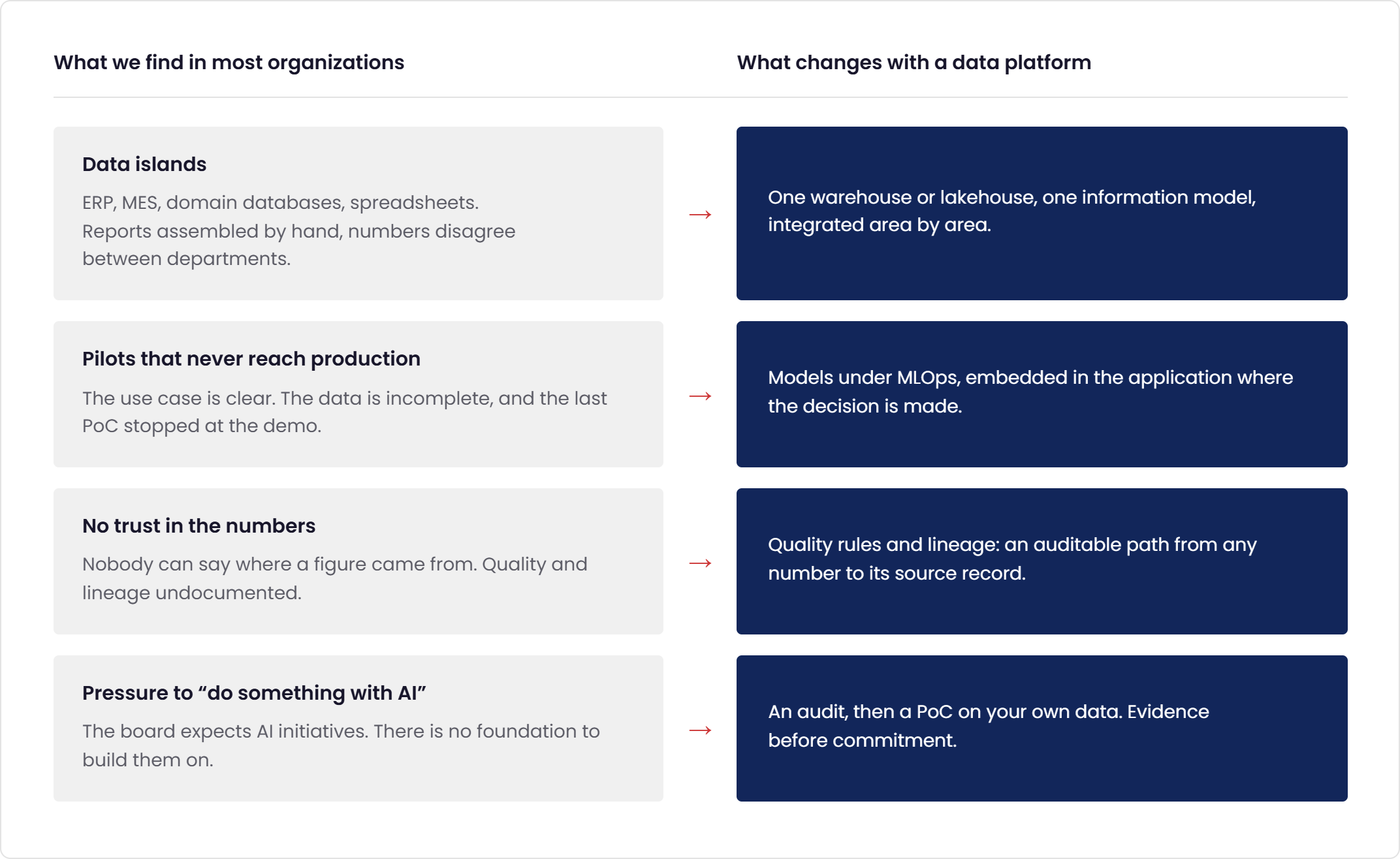
Data is spread across ERP, MES, domain databases, and spreadsheets. Reports are assembled by hand, numbers disagree between departments, and critical analysis lives in files outside IT control.What we do
- Deploy a central data platform—warehouse or lakehouse—with an agreed information model and governance.
- Establish data quality rules and full lineage, so the origin of every value is documented.
- Integrate source systems incrementally, area by area, without disrupting operations.
- Design an architecture open to further sources and use cases without a rebuild.
Examples from our project portfolio
Financial analytics on SAP data
Challenge: Group accounting relied on SAP and manual spreadsheets, and every new reporting view required IT work.
Solution: A financial data warehouse fed from SAP through a lightweight OData integration, with an optimized star schema connected to Power BI and an AI agent answering questions in natural language.
Value: Finance analyzes data without an IT queue, on one verified source that also serves as the foundation for production and laboratory data.
One reporting model across policy and claims systems
Challenge: Policy, claims, and payment data sat in three generations of systems with different customer identifiers, and every report required manual reconciliation.
Solution: A lakehouse consolidating all three under a common customer and product model, with quality rules and documented lineage behind every figure.
Value: Reports from one certified source, with an auditable path from any number back to its source record.
Metering, billing, and network data in one model
Challenge: Metering, billing, and asset data were reported separately, so every cross-cutting question turned into a one-off IT project.
Solution: A warehouse joining them on a shared location and asset key, with certified data marts and a governed self-service layer in Power BI.
Value: Business teams build their own views on agreed definitions, and questions that took weeks are answered the same day.
Start with a data architecture audit
We prepare an inventory of sources and flows, assess data readiness for AI, and deliver a map of gaps, risks, and a recommended target architecture.
2. Take an AI idea into production
When it fits
You have a use case for AI—prediction, optimization, quality control—but the data is incomplete and fragmented. Earlier proofs of concept never reached production. Expert knowledge is undocumented, and decisions depend on experience and laboratory trials.What we do
- Stabilize the data behind the process: integrations, quality rules, and document digitization (OCR/IDP).
- Train machine learning models that predict the values the process depends on.
- Operate models under MLOps: versioning, validation, drift monitoring, and retraining.
- Embed models in an application for the people who make the decision.
Examples from our project portfolio
AI for product formulation optimization
Challenge: Product quality depends on hundreds of interdependent, non-linear parameters, and formulation relied on expert judgment and repeated laboratory testing.
Solution: A central data platform with an LLM and Document AI layer that reads certificates and archives, plus ML models predicting the product properties a customer’s order requires before physical production starts.
Value: Shorter product design cycles, fewer laboratory trials, and decisions supported by data rather than intuition.
Failure risk inside the maintenance plan
Challenge: Stoppages were handled reactively, maintenance followed fixed intervals, and an earlier prediction pilot never left the analytical environment.
Solution: Telemetry and maintenance history in one platform, models scoring failure risk per asset under MLOps, with risk shown in the maintenance planning tool.
Value: Maintenance planned by risk rather than by calendar, with model accuracy held as machines and settings change.
Incoming documents read before a case is opened
Challenge: Scans and PDFs of uneven quality were classified and keyed in by hand before a case could move forward.
Solution: A Document AI pipeline extracting structured data, with a classification model routing each case and a confidence threshold sending uncertain items to a reviewer.
Value: Cases start with data already in the system, and reviewers see only what needs judgment.
Start with a proof of concept on a data sample
We define the target metric, train a first model on real data, and measure the result—a decision gate before any platform commitment.
3. Accelerate with managed cloud data platforms
When it fits
Your group has set a cloud direction and Azure, Databricks, or Snowflake are on the table. The open questions are cloud cost, whether your team can operate the platform, and how to avoid permanent dependence on an implementation vendor.What we do
- Build on managed services, so the first production increment lands in weeks rather than quarters.
- Design for cost control (FinOps), using open formats and replaceable components.
- Apply Infrastructure as Code, CI/CD, and monitoring from day one.
- Transfer knowledge through workshops and shared work until your team runs the platform.
Examples from our project portfolio
Demand forecasting and price elasticity
Challenge: Sales through retail chains were reported in aggregate, hiding lost volume—a price increase reduced units sold while total sales value appeared unchanged.
Solution: A Databricks and Delta lakehouse consolidating sales per SKU, prices, promotions, and seasonality, with models producing demand forecasts and price elasticity curves, plus automated anomaly alerts.
Value: Pricing and promotion decisions based on measured elasticity, and demand forecasts feeding production and inventory planning.
Off a capacity ceiling and onto managed compute
Challenge: The on-premises warehouse had reached its limit—nightly loads overran the reporting window, and each expansion meant a hardware purchase cycle.
Solution: Migration to Snowflake orchestrated with Azure Data Factory, incremental loading in place of full refreshes, and idle compute suspended automatically.
Value: The reporting window met again, capacity decoupled from hardware, and cost visible per workload.
A platform the client’s own team now runs
Challenge: The group had settled on Azure, but no internal team had operated a data platform, and the concern was permanent dependence on the implementation vendor.
Solution: Azure managed services delivered as Infrastructure as Code with CI/CD and monitoring, built in a shared team with the client’s engineers.
Value: First production increment in weeks, and platform operation handed to the internal team.
Start with a workshop and a pilot area
We agree on the target architecture and compare the total cost of ownership of each deployment option, then deliver one area end to end as a pilot.
4. Run data and AI on-premises
When it fits
Production data, formulations, or financial records fall under a policy that keeps them inside the company. Regulation or security requirements rule out public cloud for part of your data, and most vendors offer cloud only.What we do
- Deploy the complete platform on premises: ingestion, data lake, pipelines, warehouse, and governance.
- Run the full model lifecycle locally—training, registry, serving, and monitoring.
- Apply the same modern patterns as in cloud: lakehouse, MLOps, and access control.
- Supply GPU compute (NVIDIA servers) as part of the implementation where required.
Examples from our project portfolio
Process telemetry and production quality prediction
Challenge: Foam production quality depends on how parameters change during pouring, and batch averages lost that information—identical settings produced different quality outcomes with no way to identify the cause.
Solution: A high-resolution data repository recording process parameters continuously (~30 s intervals) instead of batch averages, with pipelines joining production and laboratory data on the client’s own infrastructure, and models identifying batches at risk of defects.
Value: Fewer defective batches and less raw-material loss, with defect risk visible in advance—and a foundation for correcting settings during production rather than after it.
An internal assistant over internal documents
Challenge: Thousands of pages of procedures and product documentation meant the answer staff got depended on who they asked—and policy ruled out an external model.
Solution: A retrieval layer over internal documents with an open-weight model served on GPU servers in the client’s data centre, answers grounded in cited passages.
Value: Consistent answers with a traceable source, and nothing leaving the organization’s own infrastructure.
Batch, process, and laboratory data without leaving the plant
Challenge: Batch records, process measurements, and laboratory results sat in validated systems that could not be replicated to the cloud, so analysis ran on spreadsheet extracts.
Solution: An on-premises lakehouse reading from those systems without modifying them, with models flagging deviation risk—training, registry, and serving all local.
Value: Analysis on complete batch history, with deviation risk visible during the campaign.
Start with an audit and a target architecture
We assess your infrastructure, data sources, and constraints, then design a target architecture with a staged delivery plan.
How we deliver
Working AI comes from a complete team, staged delivery, and governance—not from isolated experiments.
1. A complete team under one roof
- Business analysts, data and ML engineers, DevOps, security architects, and domain consultants.
- Domain consultants know your process, not only your data.
- No subcontractors, no handover mid-project.
One team, from analysis to production.
2. A staged process with decision gates
- Discovery, architecture, platform deployment, model development, and embedded AI in one flow.
- An audit and a PoC produce evidence before any commitment.
- Each stage sets the scope and budget for the next.
- CI/CD, Infrastructure as Code, and monitoring from the first increment.
Designed for production from day one—not after a pilot.
3. Sovereignty and security built in
- The same controls apply in cloud, hybrid, and on-premises deployments.
- Role-based access control, encryption, and auditability are standard.
- Data lineage documents where every value comes from.
- Delivery meets GDPR and prepares for NIS2.
- Backed by ISO 9001, ISO 27001, and Cyber Essentials.
Sovereignty without an architectural compromise.
From sources to embedded AI
Medallion architecture: how raw data becomes decisions
How an AI model reaches production
Where your platform runs
Technology—a complete stack for data and AI
Data lakes / lakehouses
Databricks
Snowflake
Microsoft Fabric
DWH / data marts
PostgreSQL
Apache NiFi
Azure Data Factory
Airflow
Spark
batch & streaming
OCR / IDP
Predictive models
computer vision
MLflow / MLOps
Explainable AI
AI agents
RAG
LLM
Azure
AWS
GCP
on-premises
Docker
Kubernetes
Infrastructure as Code
CI/CD
NVIDIA GPU infrastructure
Reference architecture for data and AI
Engagement models
Work closely with the team
Stay involved in delivery and shape the platform together with us.
- Transparent backlog and progress tracking
- Hybrid teams with your data and analytics specialists
- Shared tools, repository, and communication
- Workshops and knowledge transfer until your team operates the platform
Receive a ready-to-run solution
Let us take end-to-end responsibility for delivery.
- Regular demos and sprint reviews
- A working, tested, production-ready platform and models
- Full handover of code, configuration, and documentation
- Monitoring, support, and further development if needed
Commercial models
Fixed fee
A defined scope, budget, and delivery plan for each stage: audit, architecture, and platform increments.
Outcome-based
A lower base fee plus a premium tied to agreed, measurable criteria such as model accuracy.
Development subscription
A fixed monthly fee with allocated team capacity for continuous development and operation.
Our clients
Start small: every step ends in a decision, not a commitment.
Data architecture audit—sources, quality, gaps, target architecture. Before any decision.
Proof of concept—measurable value on your own data, in weeks.
Knowledge transfer—your team runs the platform, not us.
No lock-in: code, configuration, and documentation stay with you.
Dive deep into the world of AI-powered software development

AI can rewrite your legacy system. The hard part is proving it works.
AI can make legacy rewrites faster, but safe modernization depends on rigorous validation, differential testing, reconciliation, and controlled cutover.

AI agent development is changing the economics of custom software
AI agent development lowers software delivery costs by automating bounded tasks, accelerating modernization and making more custom projects viable at scale

Vibe coding: a fast track from idea to application, or a risky shortcut?
Vibe coding: find out what it is, where it works best, and what risks it brings. Learn when AI accelerates software development.