
Industrial IoT systems rely on a wide spectrum of communication technologies, each designed to address different operational constraints on the factory floor, in utility networks, or across large-scale infrastructure. Traditional wired protocols such as Modbus, PROFIBUS, or CAN bus offer deterministic behavior but require costly installation and provide limited flexibility in distributed environments. Wireless technologies like Wi-Fi, Bluetooth LE, or cellular standards (LTE-M, NB-IoT) extend the options, yet they often struggle in terms of energy efficiency, long-range connectivity, or the ability to support thousands of low-power devices spread across complex industrial or municipal areas.
This is precisely the context in which LoRaWAN has gained traction. As a low-power, wide-area communication protocol designed for , it fills a gap left by higher-bandwidth or higher-energy systems. LoRaWAN enables battery-powered sensors to operate for years, communicate across several kilometers/miles, and function reliably in environments with physical obstructions or electromagnetic noise.
In this article, I explore what LoRaWAN is, examine the technical strengths that differentiate it from other communication protocols, and show how it is already being used across multiple domains, including industrial monitoring, smart cities, and smart farming.
What is the LoRaWAN protocol?
LoRaWAN (Long Range Wide Area Network) is a communication protocol designed for low-power IoT devices that send small data packets over long distances. It’s built on LoRa, a physical-layer modulation based on chirp spread spectrum (CSS). This technique enables highly robust transmission, even in environments with radio interference or physical obstacles.
While LoRa handles radio modulation, LoRaWAN defines the MAC layer and network architecture. It specifies how end devices communicate with gateways, how messages are routed through network servers, and how security keys are exchanged and validated. This layered approach separates radio communication from backend processing, making networks easier to scale and manage.
LoRaWAN uses a star-of-stars topology. End devices talk directly to gateways, which forward their packets to a network server via standard IP connectivity such as Ethernet, fiber, or cellular backhaul. This topology avoids the complexity of mesh networking and allows wide-area coverage with a limited number of gateways.
A key feature of LoRaWAN is its extremely low energy consumption. Devices operate with low duty cycles and can remain in the field for years on a single battery. The protocol supports adaptive data rate (ADR), adjusting transmission parameters according to signal conditions to balance reliability and power usage.
LoRaWAN operates in unlicensed ISM bands, such as 868 MHz in Europe. As a result, organizations can deploy private networks with full control over coverage and data flow or rely on public operators where available. End-to-end encryption of both network and application layers enhances data security across the entire communication chain.
Thanks to these characteristics, LoRaWAN has become a key technology for IoT scenarios where long-range, low throughput, multi-year device autonomy are more important than high bandwidth—such as in environmental sensing, asset monitoring, and distributed industrial telemetry.
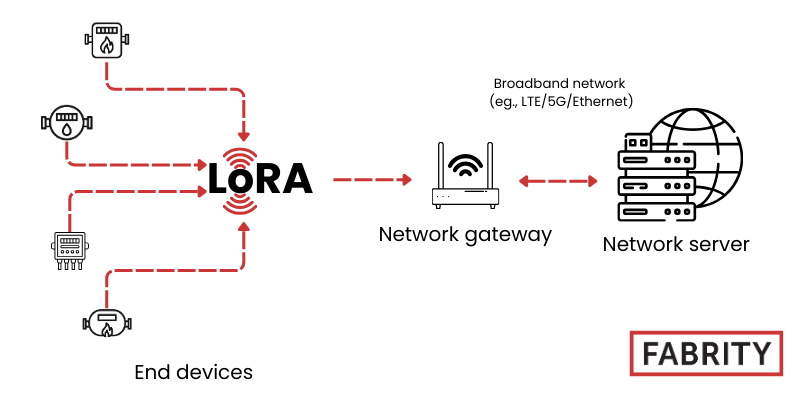
Fig. 1 The LoRaWAN network
Why choose LoRaWAN for your IoT network?
Open standard maintained by the LoRa Alliance
LoRaWAN is an open, globally recognized standard governed by the LoRa Alliance, a consortium of device makers, network operators, and technology providers. This ensures interoperability across vendors, reduces dependence on proprietary ecosystems, and guarantees long-term stability of the specification. Continuous updates from the Alliance keep the protocol aligned with evolving IoT and regulatory requirements.
Low power consumption
LoRaWAN is designed for extremely low power usage, enabling devices to operate for years on small batteries. Its low duty cycle operation and adaptive data rate (ADR) mechanism optimize transmission time and power, making the protocol particularly suitable for large, battery-powered sensor networks deployed in hard-to-reach or maintenance-heavy environments.
Long-range communication
A defining characteristic of LoRaWAN is its ability to transmit data over several kilometers, even in challenging terrain. In urban environments, ranges often reach multiple kilometers, while rural deployments can exceed ten kilometers. This wide-area coverage enables organizations to support extensive IoT infrastructures using a relatively small number of gateways. Additionally, LoRaWAN networks can operate in areas where cellular networks are unavailable.
Read more on Industrial IoT:
Predictive maintenance in manufacturing industry
Industrial IoT solutions—5 practical examples
Data acquisition: the backbone of Industry 4.0 in 2025
Edge AI technology: driving Industry 4.0 in 2025
What is a smart factory of the future and how do you create one?
Industrial IoT communication protocols: a comprehensive guide to modern connectivity
8 practical applications of AI in manufacturing
Strong, built-in security
Security is embedded directly into the LoRaWAN specification. The protocol uses AES-128 encryption of both the network and application layers, each with separate keys. This ensures end-to-end protection of payload data—even if an intermediate gateway or backhaul connection is compromised—meeting the security standards required for industrial, municipal, and utility environments.
Low cost of deployment and ownership
LoRaWAN’s operation in unlicensed ISM bands eliminates spectrum licensing fees, and hardware—both gateways and end devices—is comparatively cost-effective. Combined with long battery life and minimal infrastructure requirements, these factors make the total cost of ownership significantly lower than for many cellular or wired IoT solutions.
Network flexibility
LoRaWAN supports private, public, and hybrid deployment models. Organizations can run isolated private networks for full control and data sovereignty, rely on public operator networks for wide-area coverage, or combine both. This flexibility allows technology to adapt to industrial campuses, citywide sensors, and cross-regional IoT initiatives.
Deep indoor penetration
Thanks to LoRa’s chirp spread spectrum modulation, LoRaWAN signals offer strong resistance to attenuation. This results in better indoor and underground penetration than many competing wireless protocols. It’s particularly advantageous in industrial plants, basements, utility rooms, warehouses, and other environments with heavy structural shielding.
Continuous evolution of the standard
LoRaWAN is not static. The LoRa Alliance continuously extends the specification with new features such as advanced Class B capabilities, roaming, enhanced FOTA (firmware over-the-air), and regional parameter updates. This ongoing development ensures that LoRaWAN remains a modern, future-proof connectivity option for IoT deployments across industries.

LoRaWAN network for smart cities
The Netherlands was one of the first countries to adopt LoRaWAN at city and national scale. In 2015, the operator KPN launched pilot LoRa networks in Rotterdam and The Hague, validating long-range connectivity for municipal and industrial use. Early tests covered airport logistics at Amsterdam Schiphol, railway-switch monitoring in Utrecht, and water-depth sensors in the Port of Rotterdam. By mid-2016, the network reached full nationwide coverage, making the Netherlands the first country in the world with a country-wide LoRaWAN deployment. By the end of 2015, approximately 1.5 million IoT devices were already connected, demonstrating substantial early adoption across multiple smart-city domains.
LoRaWAN is also increasingly used to modernize municipal lighting systems. A notable example comes from Hafnarfjörður in Iceland, where the city deployed LoRaWAN-enabled streetlight controllers capable of remote dimming, fault detection, and real-time operational monitoring. The system relies on long-range, low-power communication to manage thousands of lamps without dense infrastructure or high-bandwidth links. By automating lighting schedules and enabling targeted maintenance, the deployment demonstrates how LoRaWAN can support not only urban sensing but also active control of critical city infrastructure, delivering measurable reductions in energy use and operational costs.
In Poland, smart metering became the primary driver of LoRaWAN adoption. In 2019, the city of Piekary Śląskie deployed approximately 6,500 LoRaWAN-enabled water meters across it’s territory, enabling remote readings, leak detection, and elimination of manual meter inspections. Wrocław has taken this model further, building one of the country’s largest LoRaWAN-based water-metering systems, designed for more than 70,000 endpoints and achieving near-real-time data acquisition. Additional Polish deployments cover air-quality monitoring, waste-container fill-level sensing, and early-stage smart-parking pilots, showing that a single LoRaWAN infrastructure can support multiple municipal services.
In summary: LoRaWan adoption as a global trend
According to the LoRa Alliance, by mid-2024 there were already more than 350 million LoRaWAN devices worldwide and nearly seven million LoRaWAN gateways in use. Technology is used across different verticals including smart cities, smart buildings, utilities, agriculture, industry, and logistics. In parallel, work is underway to expand the capabilities of the network, including integration with satellite communication (NTN – Non-Terrestrial Networks) and the introduction of more flexible certification processes, which make it easier to implement new projects. This clearly shows that the adoption of LoRaWAN technology is on the rise, making it an attractive option for city governments looking to deploy IoT infrastructure.