
Your next industrial IoT investment could unlock unused production capacity, catch a production fault before it ruins an entire batch, or bring older machines into a connected factory.
The challenge is deciding where that investment will deliver the greatest value. Manufacturers need a clear link between the IoT solutions they buy and the operational problems they want to solve. That link gives digital transformation a practical purpose: improving operational efficiency on the factory floor.
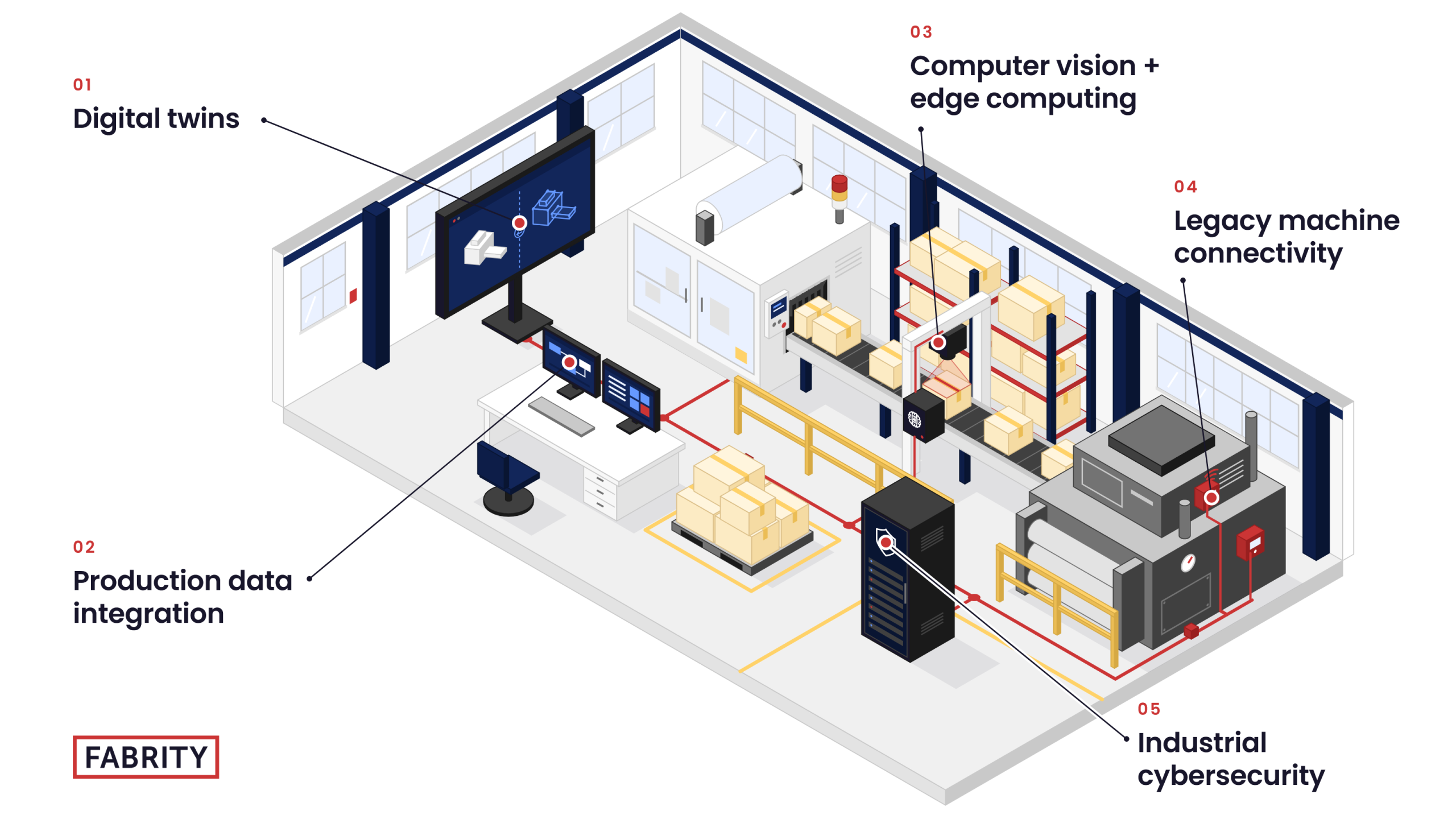
For 2027, five industrial IoT trends deserve attention: digital twins, production data integration, computer vision with edge computing, connecting legacy and modern machines, and cybersecurity. We examine what each can deliver, when it makes business sense, and how to measure its impact on the factory floor.

1. Digital twins
A manufacturing digital twin is a virtual model of a machine, production line, or process that stays synchronized with its physical counterpart. Data on cycle times, stoppages, material flows, and equipment availability helps the model reflect how production actually behaves, allowing engineers to test changes before purchasing equipment or interrupting operations.
Consider a packaging line struggling to meet demand. Engineers could use its digital twin to compare several options: installing a faster packaging machine, expanding buffers, reducing changeovers, or adjusting material delivery schedules. The model might reveal that adding capacity at one station would leave the line constrained elsewhere, while changing the sequence of work could increase output using existing equipment. By comparing these scenarios, managers can assess how much additional production each option could deliver and where investment would have the greatest impact.
PepsiCo has put this approach into practice. In January 2026, the company described how it was using digital twins and AI to simulate changes to manufacturing and warehouse facilities. Teams tested and refined configurations virtually before making physical changes. PepsiCo reported a 20% increase in throughput at its initial deployment, demonstrating the potential to uncover capacity within existing operations.
By making the likely effects of production changes visible before implementation, digital twins help manufacturers get more from existing assets and identify where new equipment would make a meaningful difference. This can reduce unnecessary spending and make production upgrades more predictable.
2. Production data integration
Digital twins help manufacturers understand how production behaves. Connecting the data behind them with business systems extends that insight to the orders, costs, and delivery commitments affected by what happens on the factory floor.
A machine stoppage, for example, can quickly become a missed delivery or an unprofitable production run. Linking IoT data and production records with analytics and enterprise resource planning (ERP) systems makes those consequences easier to assess. Planners can see which orders are affected, check available inventory, and decide whether to reschedule work or move it to another line. Purchasing and supply chain teams can adjust material requirements, while finance can trace the additional production cost. Through industrial IoT integration, a single operational event becomes useful information for teams across the business.
There is still considerable room to make better use of that information. Rockwell Automation’s 2026 State of Smart Manufacturing Report, based on responses from 1,560 manufacturing leaders across 17 countries, found that only 43% of collected manufacturing data was being used effectively.
Making data useful across systems starts with giving it context. A temperature reading becomes more informative when it is associated with a particular machine, material batch, product, and stage of production. Consistent identifiers, timestamps, and units allow records from different systems to be analysed together. Integration software can then translate machine signals into events that business applications understand, such as completed quantities, rejected products, material consumption, or downtime against an order, and use those events to automate routine tasks.
Once these connections are in place, teams can investigate both the causes and the costs of production problems. If scrap rises for a particular product, engineers can compare process conditions, material batches, and machine performance to identify what changed. Adding cost data helps them decide which problems deserve attention first: a small, recurring loss on a high-volume product may warrant more attention than an occasional, highly visible fault.
The result is a more current picture of production capacity, cost, and delivery risk. With that visibility, teams can act while the outcome can still be changed, set more realistic delivery dates, and warn customers sooner when an order is at risk.
3. Computer vision and edge computing
Some of the most useful production data comes from observing the product itself. Industrial computer vision uses cameras and image analysis, often supported by artificial intelligence and machine learning, to spot surface defects, check whether components are present and correctly positioned, and verify labels or markings. Applied during production, it gives operators a chance to catch problems before affected items move through further processing, packaging, and transport.
BMW’s AIQX quality platform illustrates this approach. It already analyses image and sensor data from production lines to detect faults and support their correction during manufacturing.
For those findings to prompt action in time, the analysis needs to keep pace with the line. Edge computing brings that processing close to the equipment, allowing models to run on an industrial computer or local server. This reduces the time and bandwidth needed to send images elsewhere for analysis, which matters when a decision must reach an operator or sorting mechanism before a product passes the inspection point. Processing on site can also continue without a cloud connection.
Local processing still allows inspection findings to contribute to the wider production picture. Results, selected images, and defect counts can feed production records and quality analysis, while cloud computing can support longer-term comparisons across lines or sites.
The same ability to recognise visible conditions can also support workplace safety. Camera-based systems can identify missing protective equipment, obstructions in walkways, or objects entering restricted areas. An alert containing an image and location gives the responsible person evidence to investigate and act on. AWS’s safety-monitoring architecture illustrates how image analysis can support both protective-equipment checks and monitoring of defined zones. Recording these events helps safety teams identify recurring hazards and assess whether corrective actions are working, alongside established safety procedures and human intervention.
Across both quality inspection and safety monitoring, performance depends on the scene as much as the model. Poor lighting, obstructed views, or unfamiliar product variants can cause missed detections and false alarms. Unnecessary rejection wastes good products, while unreliable safety alerts can undermine trust in the system.
When detection is reliable and findings reach the right people or equipment in time, the value comes from earlier intervention: less material spent on defective products, fewer avoidable rework steps, and faster responses to visible hazards. Edge computing helps make that response less dependent on external connectivity.
4. Connecting legacy and modern machines
Extending this visibility across a factory means accounting for equipment of different ages and makes. An older machine may still produce reliable parts while providing very little information about its performance. On the same line, newer equipment might report operating states, cycle times, and alarms automatically. These differences leave gaps in the overall picture of production.
Industrial gateways help close those gaps by collecting data through the interfaces each machine supports and making it available to monitoring applications. Equipment from different suppliers can then feed a shared system, giving teams a more consistent view of the line.
Where a machine offers little accessible data, additional IoT sensors can provide measurements without replacing the equipment. Data acquisition modules collect signals from compatible sensors and make them available over industrial networks. Depending on the sensors and modules selected, these measurements might include temperature, pressure, electrical current, or energy consumption. Older equipment can then contribute to production monitoring alongside newer machines.
The connection also needs to suit the location and the data being collected. For sensors spread across a large site, low-power wide-area networks (LPWANs) such as LoRaWAN can carry periodic measurements over long distances while limiting battery use. Coverage, update frequency, and the amount of data each sensor needs to send all influence the choice of connectivity technology.
The benefit becomes clearer when equipment is viewed as part of a complete production line. Consider a modern filling machine supplied by an older conveyor. The filler records frequent pauses, but its own data does not explain why products stop arriving. Monitoring the conveyor alongside the filler could reveal repeated interruptions upstream. Engineers can then investigate the cause and assess whether adjustments or maintenance improve the flow through the line.
Over time, suitable condition data and analysis can also support predictive maintenance: estimating when equipment may fail and planning maintenance before an unplanned stoppage. The value of this capability should be assessed against the line’s actual downtime and maintenance costs.
Whether the aim is to investigate stoppages or anticipate failures, the choice of signals matters. A sensor may show that a motor is running without confirming that the machine is producing good parts. Manufacturers therefore need to establish which signals answer their operational questions, how reliably they can be collected, and what additional information operators must provide. Installation, configuration, device management across the IoT network, and ongoing support all belong in the investment calculation.
For productive equipment with years of service ahead, this approach can make a practical difference. Remote monitoring can reduce manual reporting, make recurring stoppages easier to investigate, and bring more of the factory into improvement programmes while preserving the value of existing machinery.
5. Industrial cybersecurity
As gateways, sensors, and remote monitoring bring more equipment online, protecting those connections becomes part of keeping production running. A compromised maintenance account or an unauthorised change to a controller can interrupt operations, affect product quality, and complicate the restart of a line. Data breaches can also expose production records and proprietary process information.
Effective protection starts with knowing what is connected and how production depends on it. Manufacturers need an inventory of operational technology (OT), including controllers, industrial computers, gateways, and the connections between them. CISA’s guidance on OT asset inventories emphasises these relationships and dependencies. Identifying the systems that support a critical production step helps teams decide where a failure would have the greatest impact and where protection deserves priority.
That understanding provides a basis for controlling access. A supplier carrying out remote maintenance, for example, may need to diagnose a fault on one machine. Individual accounts, multifactor authentication, and access limited to the equipment and work involved help control that connection. Separating production networks from business networks, with only the necessary communication allowed between them, can also reduce the chance of an incident spreading into machine control. These measures are among CISA’s recommended protections for OT environments.
Zero trust principles reinforce this approach: being inside the factory network does not automatically make a user or device trustworthy. Access decisions should verify identity and grant only the permissions needed for the task.
Alongside these protective measures, manufacturers need a practical way to recover when an incident occurs. Backups of controller programs, machine configurations, and supporting software must be available when affected systems cannot be trusted. Teams also need a tested sequence for restoring them and checking that production can resume safely. NIST’s guidance on OT security treats recovery planning and testing as part of protecting industrial operations.
The same attention to production requirements applies to routine security updates. Compatibility and performance need to be checked before changes reach operating equipment, so that maintaining protection also supports reliable operation.
For manufacturers, the business case for cybersecurity is closely tied to the cost and duration of disruption. Recovery exercises make that connection tangible: they show how long critical systems take to restore, whether usable backups exist, and where responsibilities remain unclear. Addressing those gaps helps the factory contain incidents and return to production with less uncertainty.
Summary
Together, these technologies help manufacturers identify where production is losing time, material, or capacity and assess how to improve it. Their value depends on reliable data, integration with existing equipment and business systems, and protection against disruption. Starting with a specific operational problem makes it easier to choose the right approach and measure the results.
To discuss how industrial IoT and AI could support your production goals, contact Fabrity at sales@fabrity.pl.