
For most of the generative AI boom, AI coding tools have been framed as autocomplete. A developer begins a function, and a model suggests the next line, fills in a block, or proposes a test. The developer still owns the task and the result.
Agentic software development changes the unit of delegation.
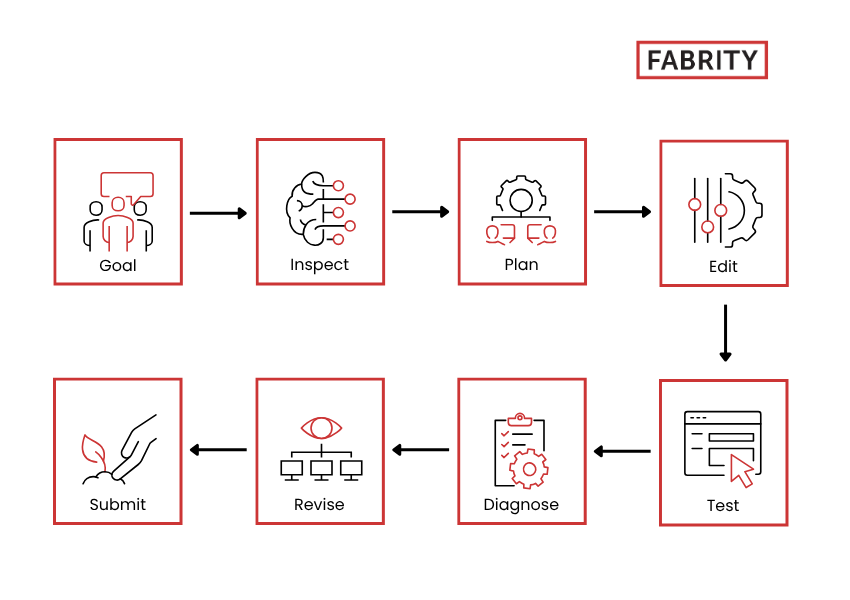
Instead of asking a model to generate a function, a developer can assign it a bounded outcome: fix a failing test, upgrade a dependency, investigate a defect, add support for an API, or prepare a pull request. The agent can inspect the repository, consult documentation, edit files, run tests, interpret failures, and revise its work before returning a change for review. The important shift is not from less code to more code. It is from generating implementation fragments to executing software tasks.
From code completion to task execution
A coding assistant helps answer, “What code should come next?” A development agent addresses a broader question: “What action should the system take next to complete the task?”
The workflow looks less like text generation and more like delegated engineering—see Figure 1 below:
Fig. 1 Delegated engineering with AI agent
Code generation remains part of the process, but what makes the system agentic is its ability to use tools, respond to feedback, and decide how to proceed within defined constraints. A well-defined agent architecture separates reasoning from data access and action execution. Structured outputs, such as validated JSON, also make agent results easier to verify and integrate into enterprise applications.
Consider a request to fix an intermittent checkout test. Autocomplete becomes useful after a developer has found the relevant code and decided what to change. An agent can begin earlier: inspect the issue, reproduce the failure, trace the affected path, implement a candidate fix, run the relevant checks, and summarize the evidence for review.
That does not justify unlimited autonomy. In an enterprise setting, agents should operate with bounded permissions, isolated environments, approval gates, and auditable workflows. Agentic development is not the absence of human control. It is the controlled delegation of execution.
Why the cost of an attempt matters
Most discussions about AI coding tools begin with a productivity question: How much faster can developers work?
That question matters, but it is too narrow.
Writing code is only one component of software delivery. The cost of a change also includes understanding the requirement, learning the codebase, locating the right systems, validating behavior, debugging failures, preparing the work for review, integrating it, deploying it, and maintaining it.
Autocomplete mainly reduces implementation effort. Agents can affect a wider portion of the workflow by exploring repositories, performing repetitive transformations, running checks, inspecting errors, updating documentation, and preparing integration evidence.
This leads to a more useful economic concept:
Agentic development lowers the cost of a software attempt.
The word “attempt” matters. Enterprises carry large amounts of work that remain unstarted because each task is too small, repetitive, uncertain, or expensive to justify.
A minor internal tool may save hundreds of hours across a business unit but still lose priority to customer-facing work. A legacy migration may be strategically necessary but repeatedly delayed because execution is tedious and risky. A product hypothesis may be worth testing but not worth the cost of building the prototype.
By lowering the cost of an attempt, agentic development can shift the software-viability frontier: the point at which expected value exceeds delivery cost, operating cost, and risk. A wider range of projects then becomes economically worth trying.
Where the viability frontier moves first
The earliest gains are likely to appear in the long tail of enterprise work: tasks with clear boundaries, observable results, and high aggregate value.
Maintenance that never reaches the top of the backlog
Large organizations accumulate thousands of small engineering tasks: dependency upgrades, missing tests, outdated documentation, low-priority defects, deprecated APIs, repetitive refactoring, fragile build scripts, and configuration cleanup.
No single task is transformative, but together they affect reliability, security, onboarding, and development speed. The constraint is often economic: assigning scarce engineering attention to each item may not be worthwhile. Agents can change that calculation by lowering the execution cost of well-bounded, verifiable work. They do not remove the need for review. They make more of the backlog affordable to address.
Read more on custom software development
AI legacy code modernization: from untouchable systems to understandable software
Vibe coding: a fast track from idea to application, or a risky shortcut?
Generative AI in pharma: A virtual assistant for smart sales
8 generative AI trends to watch in 2025
Ten business use cases for generative AI virtual assistants
A web application security checklist for every stage of development
Time and material vs. fixed-price contracts: Is there a smarter alternative?
Bounded modernization work
Modernization combines high-level judgment with large volumes of mechanical execution. Humans still need to choose the target architecture, migration sequence, risk tolerance, and business priorities. Once that direction is set, agents can help with framework upgrades, API replacements, configuration changes, tests, and repetitive transformations.
Agents are not a substitute for modernization strategy. They can become an execution layer within it.
The credible enterprise claim is not that AI will autonomously rewrite the legacy estate. It is that agents can reduce the cost and duration of bounded migration work while humans retain control over architecture and risk.
Internal software that was previously too small to build
Many enterprise processes still depend on spreadsheets, email, shared folders, and manual handoffs because replacing them with software is too specialized to compete for engineering resources.
A reporting interface for one operations team may not justify a product squad. Neither may a reconciliation tool, a custom approval workflow, or an integration between two internal systems.
As production costs fall, narrow applications become easier to justify. An application can serve a small internal audience and still be worthwhile when its development cost falls.
But cheaper creation does not mean cheaper ownership. Every internal tool creates obligations around security, support, data governance, integration, maintenance, and eventual retirement. Enterprises need both a lower threshold for building software and a clear model for owning it.
Without that discipline, agentic development could replace a coding backlog with an application-sprawl problem.
Cheaper experiments and faster learning
The cost of a software experiment includes setup, integration, instrumentation, test data, deployment, cleanup, and the possibility that the result will be discarded.
When failed attempts become cheaper, organizations can test more ideas before making large commitments. They can prototype an integration before signing a vendor agreement, compare architectural approaches through working implementations, build a temporary migration utility, or validate a customer-specific workflow before placing it on the roadmap.
The value comes not only from successful software. It also comes from cheaper learning.
The bottleneck moves downstream
There is a tempting story in which agents increase output and software organizations simply become faster. Reality will be less convenient.
When implementation becomes cheaper, other constraints become more visible. Teams may generate changes faster than they can review them. Security functions may struggle with a larger volume of code. Product leaders may face more decisions about what deserves investment. Operations teams may inherit more software than they can support.
The organization can move from a coding queue to a review queue.
More code will not produce proportionally more released software unless review, integration, deployment, adoption, and operational ownership expand with it. The limiting factor shifts from producing changes to deciding which are trustworthy, useful, and supportable.
That is why lines of code, generated patches, and raw commit counts are poor measures of enterprise value. A stronger measurement system focuses on outcomes such as:
- lead time from accepted task to production;
- human review hours per accepted and released change;
- first-pass acceptance rate;
- rework required before approval;
- escaped-defect and rollback rates relative to a human-only baseline;
- completion and failure rates by task category;
- reduction in maintenance backlogs;
- total cost per released change; and
- business value created by projects that previously failed the investment threshold.
Continuous evaluation and monitoring are essential because agent performance may change as models, data and software environments evolve. An early data audit can help identify quality, accessibility and governance issues before they affect deployment.
Results should be segmented by task type. A single overall completion rate can hide strong performance on dependency upgrades and weak performance on ambiguous product changes. The goal is not maximum agent activity. It is maximum trusted, maintainable, useful output.
Repositories—and tasks—become agent infrastructure
A capable model is only one part of an effective agentic-development system. Its environment matters just as much. Agents also need reliable connections to repositories, databases, APIs and enterprise systems such as CRMs and ERPs. Integration complexity and legacy-system compatibility can therefore become major barriers between a successful proof of concept and production deployment.
Human engineers can compensate for missing documentation, inconsistent commands, fragile tests, and undocumented architecture through experience. Agents become less reliable when expected behavior and repository conventions remain implicit.
If a repository does not build consistently, the agent cannot trust the build. If tests are missing, it cannot verify behavior. If interfaces are inconsistent, it must infer rules that humans may know but have never documented. If expected outcomes are unclear, it may optimize for the wrong result.
Tests, types, linters, documentation, modularity, reproducible environments, and standard development commands therefore become more than quality controls for people. They form the feedback surface through which agents work.
Task quality matters too. Agents need clear acceptance criteria, observable outcomes, defined constraints, and reliable verification. A vague issue in a brittle repository is not an automation opportunity; it is an ambiguity multiplier.
Repository quality and task specification become part of the AI infrastructure.
Organizations with well-structured repositories, reliable verification, and explicit architectural boundaries will be able to delegate more work safely. Those with brittle systems and hidden knowledge may discover that buying an agent does not remove technical debt. It exposes it.
Controlled autonomy must be designed into the workflow
The safest adoption path does not begin with maximum autonomy. It begins with work that is clearly defined, easy to verify, reversible, and limited in scope.
Strong early use cases include dependency updates, contained bug fixes, tests for existing behavior, documentation maintenance, low-risk migrations, repository investigation, and pull-request preparation.
A practical maturity path can progress through four stages:
- Assist: Explain code, answer repository questions, and suggest edits.
- Execute: Modify files and run checks inside an isolated environment.
- Deliver: Complete bounded issues and return reviewable pull requests.
- Integrate: Participate in governed downstream workflows where performance, permissions, and risks are well understood.
Governance should shape what the agent can see, decide, and execute from the beginning—not appear only at final review.
That includes least-privilege access, isolated execution, restricted network connectivity, protected secrets, approved tools and dependencies, branch protection, mandatory review, complete action logs, and policy-based approval gates.
Different tasks require different autonomy. Summarizing a repository presents a different risk from changing production infrastructure; opening a pull request is not equivalent to merging and deploying it.
The right question is not whether agents should be autonomous. It is where autonomy is justified by task clarity, reversibility, observability, demonstrated performance, and business value.
Greater autonomy should be earned through evidence.
Engineering work shifts toward judgment
Agentic development will change the role of software engineers, but not in the simplistic way often suggested.
Developers may spend less time producing every implementation detail and more time defining problems, decomposing work, setting constraints, designing architecture, reviewing evidence, and making trade-offs.
They will need to decide which tasks are suitable for delegation, write effective acceptance criteria, evaluate results, and preserve coherence across a growing volume of changes.
Engineering leaders will face a new capacity problem: coordinating developers, coding assistants, supervised agents, automated workflows, and review queues as one delivery system.
This makes human capabilities such as product judgment, architecture, domain knowledge, security thinking, system-level debugging, communication, risk assessment, and ownership more valuable, not less.
Agents can execute tasks, but they should not own the decision about which tasks deserve investment.
The real opportunity is a new software-economics curve
Agentic development is often presented as the next generation of coding assistance. That description understates its potential. The important shift is that software organizations can begin delegating bounded parts of the development workflow itself. For enterprises, this can mean faster modernization, smaller maintenance backlogs, more internal automation, more experiments, and a wider range of software projects that make economic sense.
But the advantage will not belong to the companies that generate the most code. It will belong to those that build the strongest system for selecting tasks, constraining agents, verifying results, integrating useful changes, and maintaining what gets built.
The strategic opportunity is larger than building the same roadmap faster. It is making a new class of software economically worth building.